



Women in Trees
By Jean Ponzi
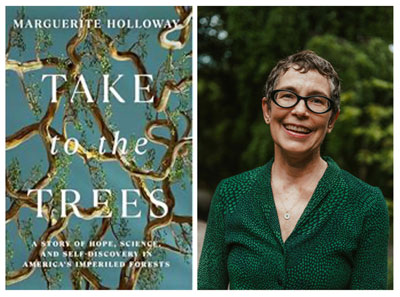
Carabiner’d and harnessed like an arborist pro, to climb just 15 (daunting) of 80+ towering feet into an elder Hemlock, journalist Marguerite Holloway embodies all the themes she explored over several years showing up “to be in trees and better understand them.”
Reading her resulting book, I feel with her: grateful, uplifted, heartbroken, determined!
Take to the Trees (Norton, 2025) is subtitled A Story of Hope, Science and Self-Discovery in America’s Imperiled Forests. This work sprouted from a New York Times assignment to report on issues in Central Park’s urban forest. There Holloway met twin sister tree doctors Bear LeVangie and Melissa LeVangie Ingersoll, whose Women’s Tree Climbing Workshop became an open-hearted writing professor’s route to ascent.
The workshop network getting women into trees includes instructors who are tree-climbing champions, women whose disciplines cope at once with strenuous work in complex spaces and human society’s full range of sexist, misogynistic aggressions.
Workshop participants are women in their 20’s to 80s, from all backgrounds. Holloway shares the struggle and joy she finds learning climbing with new friends like June Moulis, a professional plantswoman who strives to regain her arborist stamina and skills after seven years downed by Lyme disease.
I’ve been fortunate working in women-led teams throughout my career. While our gender is not a good-colleague guarantee, when compared to standard-practice patriarchy collaborating with women can feel and function as another world. Holloway leafs out this landscape of experience, relating how women climbing trees affirm self and others, with encouraging compassion and required mastery of hi-tech ropes and historic knots.
Journalistic diligence and her canopy view have Holloway seeing in detail the intense threats to trees, from global-trade hitchhiking bugs and seeds to building-boom “development” to grab-it-all extraction wherever there’s money to be made. Mostly human impacts, but even fungus contributes to what Holloway will not understate, a Great Dying.
I loved learning about the trees she learns from: ash, aspen, Atlantic white cedar, beech, oak, whitebark and Wollemi pine. In chapters accented by Ellen Wiener’s elegant black and white drawings, Holloway brings to life tree anatomy, physiology, ecology and more. Her reports from a host of experts share tree characteristics and declines that had me, many times, feeling both in awe and in tears.
And yet, tree and human resilience stand strong in this story. Holloway connects us to people who study and care for trees, who couple our species’ knowledge with Nature’s vast capacity to recover and restore. Hope gets into her subtitle thanks to facts and because she’s a person willing to own that trees are capable of more than we know.
Melissa and Bear’s workshop girdles the male dominance in their profession – and life overall – by teaching and coaching women to skillfully, safely climb and move around in trees. They’re growing their short-handed arborist field while cultivating confident, cooperative nature-connection in fellow/sister humans – and an innovative livelihood for their entwined families!
The familial theme branches into Marguerite Holloway’s personal life, making her book as much memoir as superb environmental report. Trees reconnect her profoundly to her mother and brother, beloveds who left life through respectively bleak dementia and suicide.
Grounded in renewal, Holloway’s perspective has oak strength throughout her book. Reading her work has strengthened me.
Jean Ponzi will interview this author and moderate a panel of local tree experts at an evening public program on Nov 9, presented at WashU by the Landscape and Nursery Association of Greater St. Louis. Admission is free for limited space, so registration is required. Visit LNAGSL.org/trees.